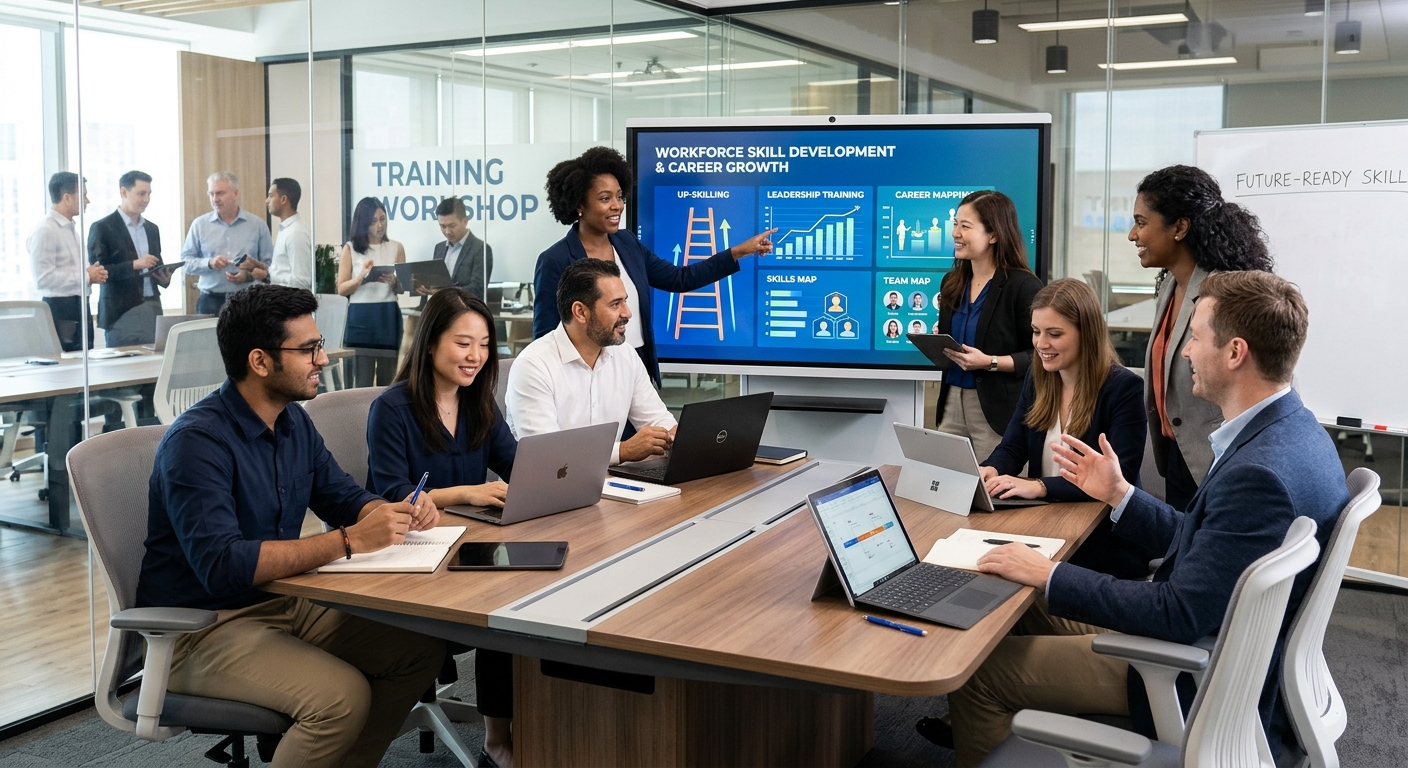
Shifting job roles and emerging workplace technologies make workforce capability planning an ongoing operational priority. Organizations that treat employee development as a reactive checklist struggle with attrition and prolonged hiring cycles. Structured upskilling and reskilling programs close competence gaps while helping internal talent progress into high-impact responsibilities.
Distinguishing Between Upskilling and Reskilling
While often grouped together, the two strategies address distinct organizational needs:
- Upskilling: Deepens existing capabilities within an employee's current domain. A financial analyst learning advanced data modeling or an HR generalist mastering learning automation represents targeted upskilling.
- Reskilling: Prepares employees for entirely new job functions when their current roles change or sunset. A customer service representative training to become an IT systems specialist is a direct reskilling path.
Key Pillars of a Sustainable Skill Development Program
Scaling skills across distributed divisions requires deliberate alignment between talent objectives and digital learning delivery:
1. Role-Based Competency Benchmarks
Define clear capability frameworks across departments. When staff understand exactly what technical proficiencies and leadership markers qualify them for adjacent roles, self-directed learning participation rises sharply.
2. Modular Learning Paths and Micro-Credentials
Replace multi-day offsite workshops with modular digital pathways that fit into standard work weeks. Breaking comprehensive curricula into 15-minute lessons with embedded practical checkpoints helps professionals learn continuously without disrupting core deliverables.
3. Integrated Real-Time Skill Dashboards
Combine quiz performance, course completion milestones, and manager assessments into centralized analytics dashboards. Leadership can spot emerging capability shortfalls months ahead of quarterly business reviews and reallocate training resources accordingly.
Translating Training Into Performance
Workforce development succeeds when employees apply newly gained knowledge to current projects. Pairing structured course pathways with team mentorship and project-based evaluation ensures that skill investments drive measurable business outcomes.

David K. Chen
Head of Learning Architecture & AI Pedagogy
David K. Chen is a learning architect and EdTech researcher specializing in adaptive learning frameworks, micro-learning methodologies, and skill graph architectures. He advises organizations on transitioning from rigid training curriculums to agile, continuous workplace learning models.